

I was passing through Sheffield recently and spent some time walking through the successive phases of the city’s acclaimed Grey to Green initiative.
If you read most of the industry commentary on Grey to Green, it is almost exclusively praised through the lens of green infrastructure, climate resilience, and biodiversity. And rightly so. The engineering behind its Sustainable Urban Drainage Systems (SuDS) and the multi-layered perennial planting are undeniable triumphs.
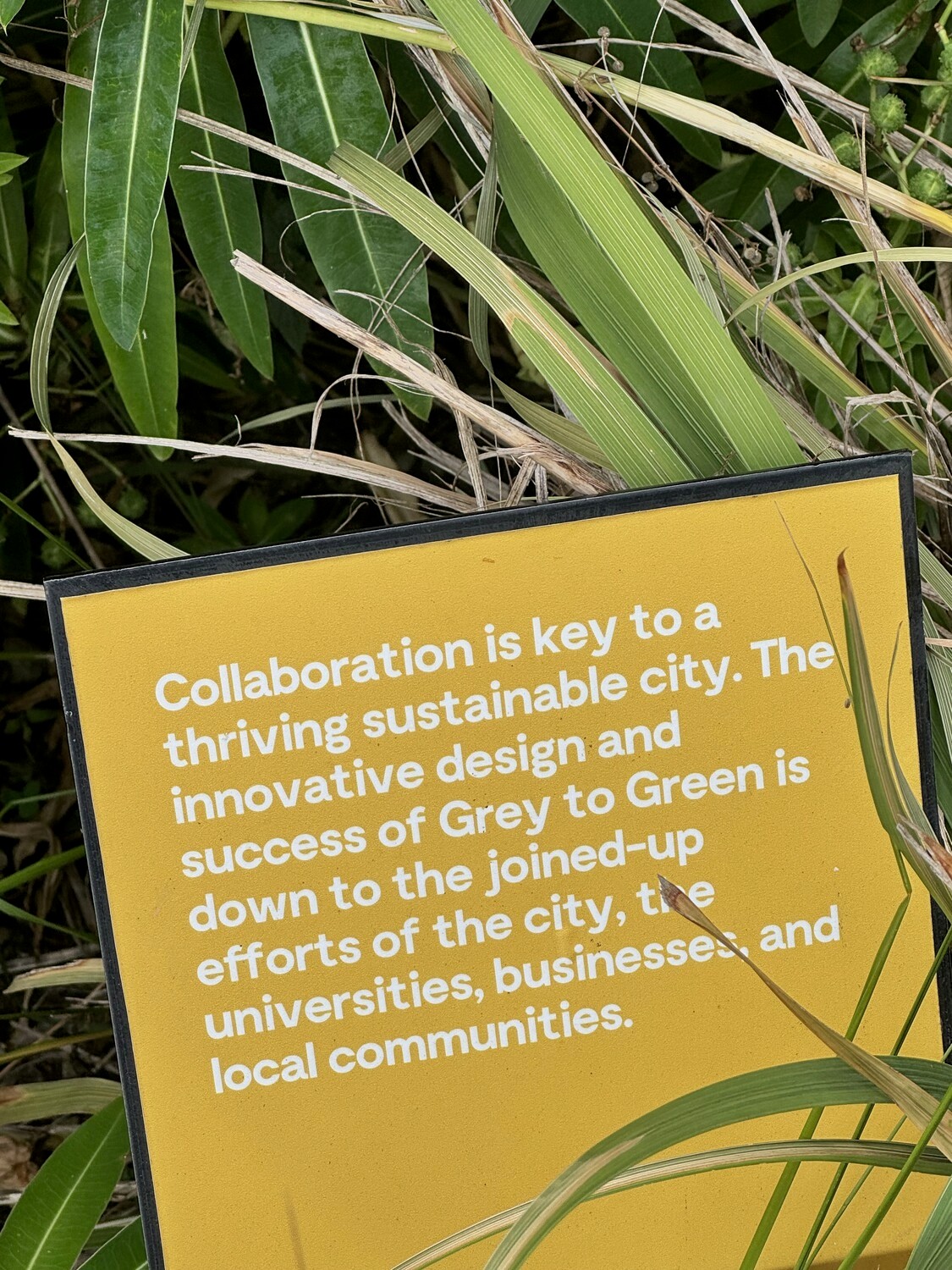
But walking the ground as an urban designer first and a dual-chartered landscape architect and town planner second, I saw a completely different narrative.
To me, Sheffield hasn’t just built a sustainable drainage network or a thread of urban greenspaces. They have successfully demonstrated a highly sophisticated, cost-effective model for urban regeneration, property value creation, and infrastructure repair.
The Cost of “Open-Heart Surgery” on Cities
On a traditional property and infrastructure model, repairing a fragmented, car-dominated city centre is a financial nightmare.
To pacify massive, redundant highway systems, a local authority or developer would typically have to go through the gruelling process of multi-million-pound land acquisitions, structural demolitions, and complex engineering overhauls. It is the urban equivalent of major open-heart surgery. It is slow (making it susceptible to political and funding shifts), incredibly disruptive, and often financially unviable.
Look at the fabric of the areas where Grey to Green was deployed (like West Bar and Castlegate). Architecturally, there isn’t a unified style. The building frontages are inconsistent, the edges are jagged, and public spaces historically lacked clear definition. The dominant feature was an aggressive, oversized asphalt dual-carriageway slicing through the townscape, of the kind that every mid-size UK town and city has.
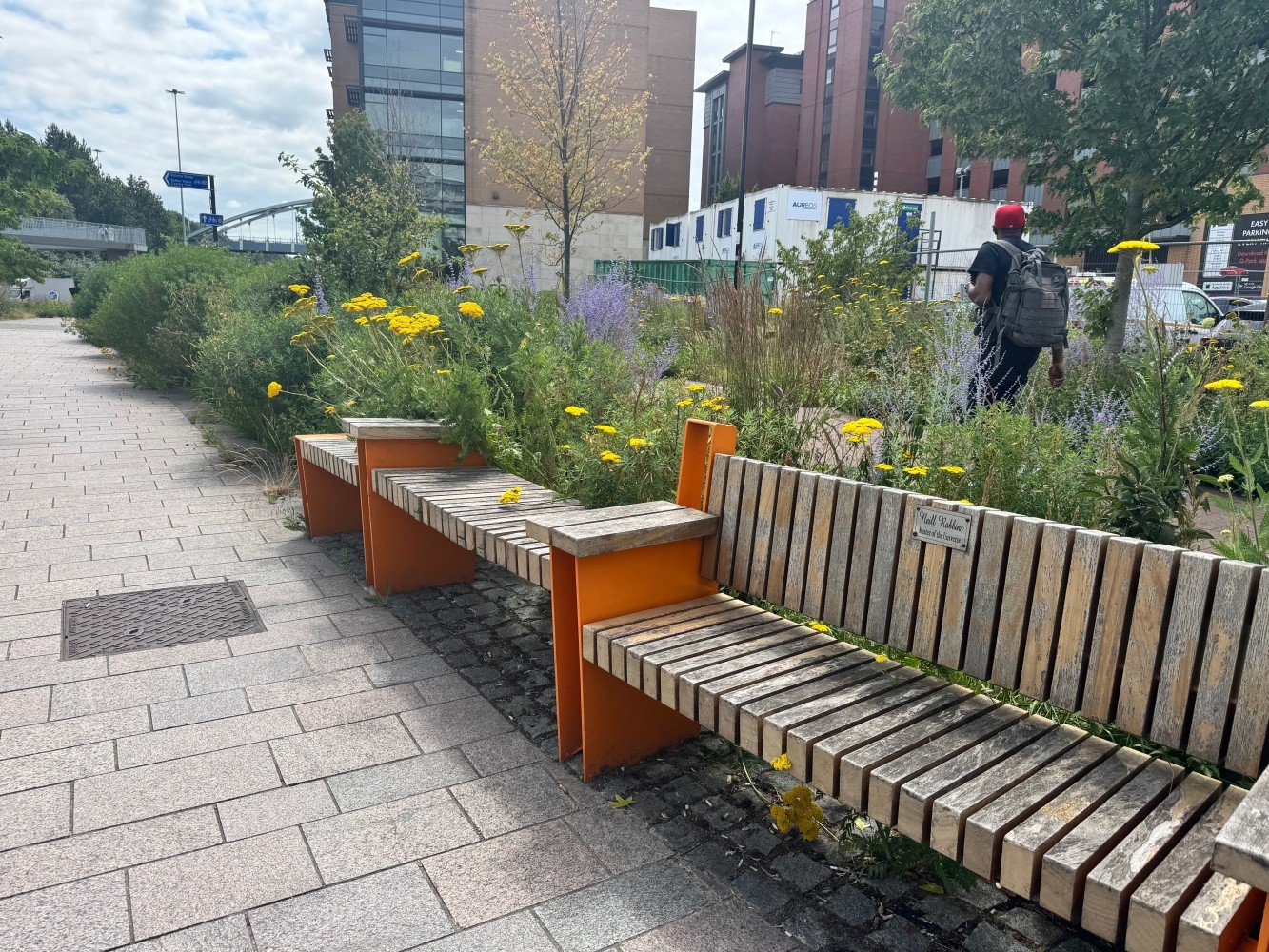
Instead of fighting the architecture or attempting a multi-billion-pound redevelopment of the built form, Sheffield’s civic leaders and technical officers did something incredibly smart: they leveraged the power of elite landscape design to hold a difficult city together.
By narrowing the redundant highway and introducing planting of exceptional quality and maintenance, they created a powerful visual and physical glue. It softens the inconsistent architecture, establishes a premium public realm, and entirely reframes the street scene. They didn’t change the buildings; they changed how the space between the buildings performs.
The Human and Commercial Proof
The evidence on the day I visited was undeniable. People don’t sit in the middle of a dual carriageway to check emails, catch up with colleagues, or have a coffee. Yet, there they were.
The public has responded to this intervention incredibly well. The space feels active, safe, and distinctly high-value. And that is the ultimate metric for regeneration success. By transforming redundant tarmac into a desirable public realm address, Sheffield has quietly unlocked surrounding land value, acting as a direct catalyst for major new private sector developments nearby, like West Bar.
This success didn’t happen because of an architectural intervention. And it wasn’t the result of a meticulously scrubbed, blank-slate masterplan. It worked because it utilised landscape infrastructure to solve a complex commercial and spatial problem.
The Power of Cultural and Strategic Continuity
There is a final, vital lesson here for civic leaders, technical officers, and consultants across the UK: continuity matters.
Too often in Urban Design, a local authority delivers a brilliant Phase 1, gets distracted by a new political cycle or funding pot, and moves on to something else. Sheffield didn’t do that.
They have shown an enviable, long-term institutional commitment to this vision:
2014–2016 (Phase 1): Started around West Bar, proving the concept and transforming 0.7km of redundant dual-carriageway.
2019–2022 (Phase 2): Expanded into Castlegate and Exchange Place, tackling a further 1.3km green corridor.
A Decade of Evolution: Now, years after inception, the strategy continues to mature, backed by a dedicated approach to ongoing maintenance that protects the initial capital investment.
This decade-long consistency means the green infrastructure has scaled up to the point where it completely dictates the identity of the district.

The Takeaway for Inward Investment
We do not always need to rely on high-risk, high-cost demolition to fix our towns and cities. From a viability perspective, we need to stop thinking of landscape design as an aesthetic “add-on” at the end of a project.
When properly integrated with Town Planning and Urban Design principles, elite Landscape Architecture is the infrastructure. It is the spatial glue that resolves structural complexity, mitigates development risk, and unlocks exceptional property value out of thin air—or in Sheffield’s case, out of old tarmac.


