

Over a decade ago, back in 2012, I was part of the very first South Wales Metro Impact Study, which began the advocacy process that has led to the Metro for the Cardiff Capital Region. We wrote passionately about a land-use revolution: Transit-Oriented Development (TOD). Our vision was a network of high-density, vibrant, mixed-use communities anchored by rapid transport hubs.
Fast forward to 2026. Phase 1 and the Core Valley Lines transformation are largely live. We have the tracks, the electrification, and the shiny new tram-trains are about to be launched. Transport for Wales has delivered a brilliant transit system.
But if we are being completely honest, where is the development and regeneration enabled by infrastructure investment? Where is the public sector capturing land value uplift and reinvesting it into future projects? We have successfully built the spine of the network, but we haven’t built the places or repurposed the places that are already there.
The 5-Year Policy Vacuum
The knee-jerk response from our industry is often: “We need better spatial planning policy and sharper design guidance.” But let’s look at the cold, hard facts. We are operating in a massive policy vacuum. The majority of Local Development Plans (LDPs) across the Cardiff Capital Region are heavily out of date, and we won’t see a legally binding Strategic Development Plan until 2030 or 2031 at the earliest.
If we sit around waiting for spatial planning to save us, we are losing five critical years.
Furthermore, we are facing an institutional crisis. Local government has sadly lost the capacity and the organisational muscle memory required to take on complex, brownfield sites and package them for private sector partners. Ten individual, stretched local authorities cannot independently navigate complex public-private partnerships. They need assistance, guidance and practical hands-on support. This is not just for Metro-led regeneration, but any property-based regeneration.
The Psychological Trap of ‘Infrastructure Later’
Even with the right policy, getting the sequencing right is a challenge - by putting development first and infrastructure second—we hit a massive psychological pitfall: we lock in car dependency.
Look at Plasdŵr in North West Cardiff. It was allocated as a sustainable “Garden City” anchored by a Metro light-rail corridor. Today, thousands of homes are built, but the Metro line remains unfunded and nonexistent. The moment a family moves into a new home without a transit link within a short walk, they get a car, or two, perhaps even three. Their daily habits form around the road network. Trying to retrospectively coax them onto a train a decade later will be a monumental uphill battle.
Compare this to Ørestad in Copenhagen, which I visited in 2013. The Metro line, vehicles, and stations were put in first, sitting among some excellent early phases (such as 8 House) and a swathe of unfinished sites. Because infrastructure led the way, residents’ habits formed entirely around transit and cycling from day one.
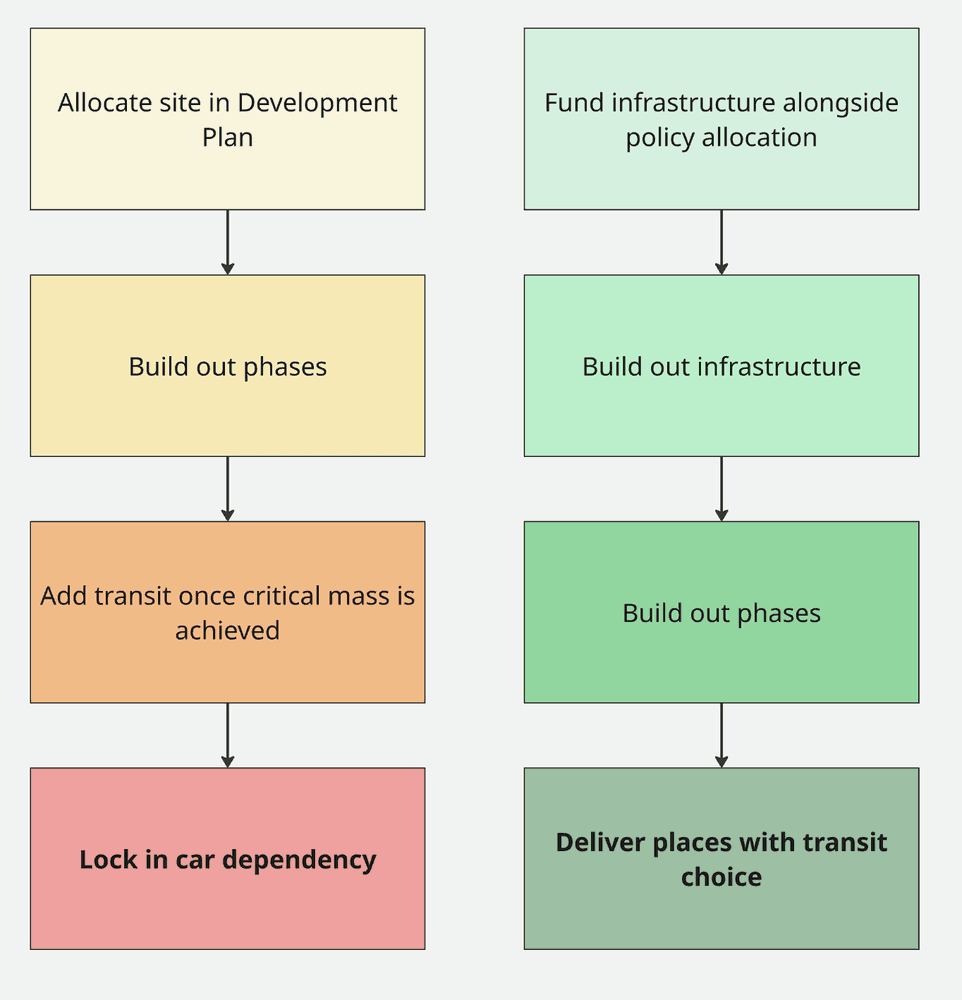
The traditional way of bringing forward large sites vs the way we should be doing things
Shifting from ‘Planning-Led’ to ‘Development-Led’
To unlock exceptional value across South Wales and the South West, we must stop expecting policy alone to fix market viability. If a site doesn’t stack up financially, the private sector will not build it, no matter how captivating our development proposals look.
During this 5-year planning vacuum, the public sector must shift from a passive regulator to a proactive Master Developer. We need a single, centralised entity equipped with the commercial skills, funding, planning, and legal authority to aggregate land, absorb upfront financial risks, and package “oven-ready” sites for the market.
Talk of a ‘WDA 2.0’ suggest a new body could eventually hold these exact powers within its remit. But let’s be realistic: that will take at least two years to get off the ground. We cannot afford to sit on our hands in the interim. We must aggressively leverage our existing governance, delivery, and policy architecture immediately while the long-term successor is ironed out.
We must use public capital to de-risk these Metro sites upfront—absorbing in-ground risks, sorting utilities, and securing flexible, commercially appropriate outline consents. Once a site is oven-ready, the private sector can be brought in through targeted Public-Private Partnerships to deliver via Reserved Matters. Once development is derisked, there is no shortage of capital to make new places happen.
We know this model works because we been involved in one that proves it. At 71/72 The Kingsway for Swansea Council, we worked with the Council, who tackled the structural friction upfront, proved the market, closed the viability gap and got what they needed built and fully occupied.
Placemaking Doesn’t Stop at the Platform
True equity in regional growth means ensuring the Metro doesn’t stop at the station platform. We must aggressively fund “last mile” infrastructure—creating a seamless, integrated network of landscape improvements, active travel corridors, and regulated bus networks that feed the rail hubs.
It’s not an absence of ambition or a lack of design ability that is holding us back. Spatial planning and Urban Design will only ever be as good as the delivery models available to make them happen. We have the tracks and the trains; now we need the centralised, commercial muscle to build the places.


